
Torrone – the Italian Nougat with Pistachio for Christmas
This is an Italian nougat made from honey, sugar, and egg whites, with almonds, hazelnuts, or pistachios. It’s very hard and often enjoyed in small pieces, especially from places like Cremona, famous for its Torrone. As an interesting trivia, legend says that Torrone’s origins are linked to the marriage of Bianca Maria Visconti and Francesco Sforza in 1441 in Cremona, with the confection symbolizing the city’s towers. This is because the 2 glazings are always (traditionally) done together. However, you could do only one if you prefer. And another interesting trivia says that these kind of sweets have been documented as far as the ancient Roman world. So, this is an at least 2000 years old dessert – talking about tradition in Europe!

The Torrone Morbido (Soft) Recipe Card
Torrone Soft

This soft Italian nougat candy made from egg whites, honey, sugar, and nuts, will delight your senses with its chewy texture and delicate flavors.
Ingredients
- 1 cup honey (preferably acacia for its mild flavor)
- 1 cup granulated sugar
- 2 medium egg whites, at room temperature
- 1 cup pistachio (or a mix of almonds and hazelnuts), toasted and roughly chopped
- Zest of 1/2 lemon or orange (optional)
- Wafer paper (for lining the mold, to prevent sticking; optional)
- A pinch of salt
Instructions
- Prepare the Molds: Line a rectangular mold or baking dish with wafer paper if using, or parchment paper greased with a bit of oil.
- Heat Honey and Sugar: In a heavy-bottomed saucepan, gently heat the honey over low heat until it starts to boil. At the same time, in another saucepan, melt the sugar with a little water to create a syrup, cooking until it reaches the hard ball stage (250°F/120°C).
- Whip Egg Whites: While the honey and sugar are heating, whip the egg whites with a pinch of salt until stiff peaks form.
- Combine: Slowly pour the hot honey into the egg whites while continuously beating them. Once incorporated, slowly add the sugar syrup in the same manner, beating until the mixture is thick and has cooled slightly.
- Add Nuts: Fold in the chopped nuts and zest if using.
- Set: Pour the mixture into the prepared mold. Smooth the top with a spatula or wet hands. Allow to cool at room temperature for several hours or overnight until firm but still soft.
- Cut and Serve: Once set, remove from the mold, peel off the paper if used, and cut into pieces using a sharp, oiled knife. Store in an airtight container.
The Torrone Durro (Hard) Recipe Card
Torrone Durro (Hard Nougat)

The Torrone Duro (Hard Torrone) uses essentially the same ingredients as the morbido (soft) version, but with a bit more egg whites and an extended baking time to harden the egg whites.
Ingredients
- 1 cup honey
- 1 cup granulated sugar
- 4 large egg whites
- 3 cups almonds, lightly toasted and whole or roughly chopped
- 1/2 cup corn syrup or glucose (for a smoother texture; optional)
- Wafer paper for lining the mold
- A pinch of salt
Instructions
- Prepare Molds: Line your molds or a baking dish with wafer paper.
- Cook Honey and Sugar: In a saucepan, heat the honey until it begins to boil. Simultaneously, in another pot, cook the sugar and corn syrup (if using) with a bit of water until it reaches the hard crack stage (300°F/150°C).
- Whip Egg Whites: Beat the egg whites with salt until they form stiff peaks.
- Combine: Carefully pour the hot honey into the egg whites, beating constantly. Follow with the sugar syrup, continuing to beat until the mixture thickens and cools a bit (it should not be too hot to add nuts, but still hot enough to cook them slightly).
- Add Nuts: Quickly stir in the almonds, ensuring they are well distributed.
- Pour and Set: Immediately pour the mixture into the prepared mold. Smooth the top. Allow to cool completely; this can take several hours or overnight.
- Cut: Once completely set and hard, use a sharp, oiled knife or a heavy cleaver to cut into pieces. Torrone Duro is often sold in large blocks and broken into pieces by hand.
Tips for both recipes
- Temperature Control: Use a candy thermometer for best results, especially for Torrone Duro.
- Nut Toasting: Toasting nuts enhances flavor but be careful not to burn them.
- Storage: Both types of torrone can be stored in an airtight container at room temperature. Hard torrone will keep longer due to its lower moisture content.
What is the difference between torrone morbido and torrone durro?
The primary difference between torrone morbido and torrone duro lies in their texture:
- Torrone Morbido (soft nougat) has a chewy, softer consistency. It’s made by cooking the mixture of egg whites, honey, sugar, and nuts for a shorter time, which results in a more pliable texture.
- Torrone Duro (hard nougat) is characterized by its crunchy, brittle nature. This version is cooked for a longer period, allowing the sugar to caramelize more, which hardens the nougat once it cools. The nuts in torrone duro are often more uniformly distributed and can provide a contrast to the crispiness with their own texture.
Both types share similar base ingredients, but the cooking time and temperature significantly affect the final product’s texture.


What’s the difference between nougat and torrone?
Nougat and torrone share a common foundation but have distinct differences based on origin, preparation, ingredients, and cultural significance:
Origin and Cultural Context
While Nougat is a broader term encompassing various sweet confections from around the world, with significant versions in France (Nougat de Montélimar), the Middle East (like Gaz in Iran), and America, the Torrone is specifically Italian, with a strong association with Cremona where it’s a traditional Christmas sweet. Various regions in Italy offer their own versions.
Ingredients
Both use a base of honey, sugar, and nuts, but:
- Nougat can vary widely: you will find the White Nougat (like French nougat) that uses egg whites, almonds, and sometimes other nuts like pistachios, with flavors like lavender or orange blossom water. But at the same time you will find the Brown Nougat (common in American candy) which does not use egg whites, but caramelized sugar instead, and could include different nuts, marshmallow fluff, or corn syrup.
- Torrone: involves a meticulous process of cooking the sugar and honey to the right consistency before adding nuts and egg whites. The exact method can vary by region, affecting the final texture.
Cultural Significance
- Nougat might be enjoyed year-round or be part of various celebrations worldwide, not tied to a specific holiday in all cultures.
- Torrone is particularly associated with Christmas in Italy, though enjoyed at other times as well, with each region celebrating its version.
In essence, we can conclude that Torrone is a subset of nougat, defined by its Italian heritage and traditional preparation. Nevertheless, it looks like this was close to the original recipes, thousands of years old, and all the other variations went from there on. I don’t know why but it makes me dream when strolling through Rome at this same axact dessert enjoyed by gladiators in their fighting breaks and patricianas in sandals.
What are the variations of Torrone in other parts of Italy?
Torrone, while famously associated with Cremona, exhibits a rich diversity in other parts of Italy, with each region adding its unique twist to this traditional nougat:
- Sicily: Known for Torrone di Caltanissetta, whit pistachios, and di Giuggiulena, which is made with sesame seeds and honey
- Abruzzo: often soft with chocolate
- Campania: Iuses candied fruit instead of almonds
- Piedmont: As this region is abundant in hazel nuts you will find here a crunchy sortiment of nougat
- Sardinia: The torrone here can be flavored with local ingredients like lemon, and it’s often lighter in color. That is why it has an ivory hue.
- Tuscany: Siena’s torrone is distinctive for using spices like cinnamon, adding a warm, aromatic note to the confection.
- Lazio: the torrone you will find in Lazio has a thin coating of dark chocolate with pine nuts, which is delicious.
How is Torrone served in Italy on Christmas?
As with any Christmas dessert, torrone has its spot in the celebrations. We usually slice it up at the table, or I’ll wrap some in pretty paper to give as gifts, making everyone feel a bit of that holiday warmth.
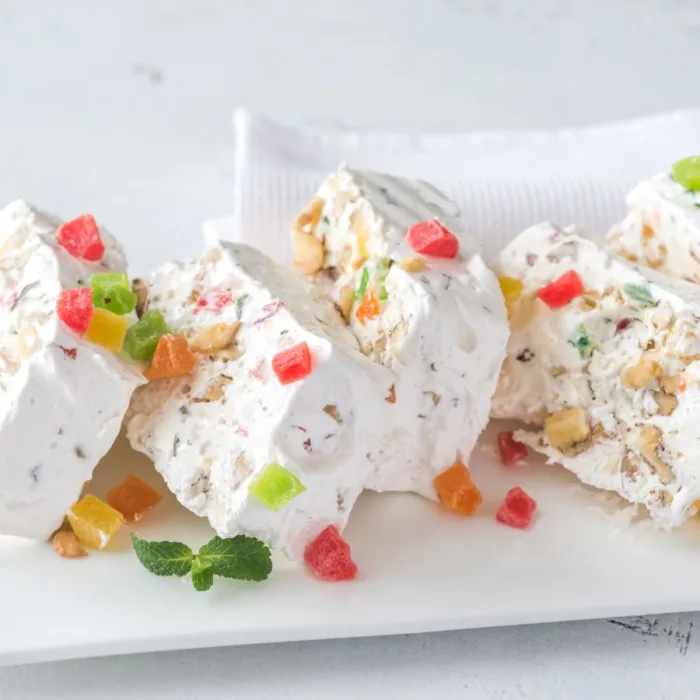


- Large slices or small pieces: Especially during the holiday season in Italy, torrone is often served in its full, large form or cut into thick slices or small pieces and presented at the end of a meal as part of a dessert selection.
- With dessert wines: In Italy, particularly during festive occasions, torrone pairs wonderfully with dessert wines like Vin Santo or Passito. Or even with a Vin Brule. The sweetness and texture of torrone complement the rich, sweet flavors of these wines, be they warm or cold.
- In confectionery displays: During festivals, torrone can be part of elaborate displays at the family, usually grandmother’s table, often wrapped in decorative packaging or served alongside other traditional Italian sweets.
- With coffee: After meals or as an afternoon treat, small pieces of torrone can be enjoyed with coffee. I find the combination of the sweet, nutty flavor with the bitterness of coffee quite delightful. And I am not unique amongst my fiends in this respect!
- In culinary uses: Beyond just serving it as is, torrone can be incorporated into recipes. For instance, crumbled hard torrone might be used as a topping for ice cream, or soft torrone could be melted down for use in baking or as a filling for pastries.
What other flavors of nougat does one find around the world?
Being such on old dessert, Torrone has variations worldwide, reflecting local tastes and ingredients:


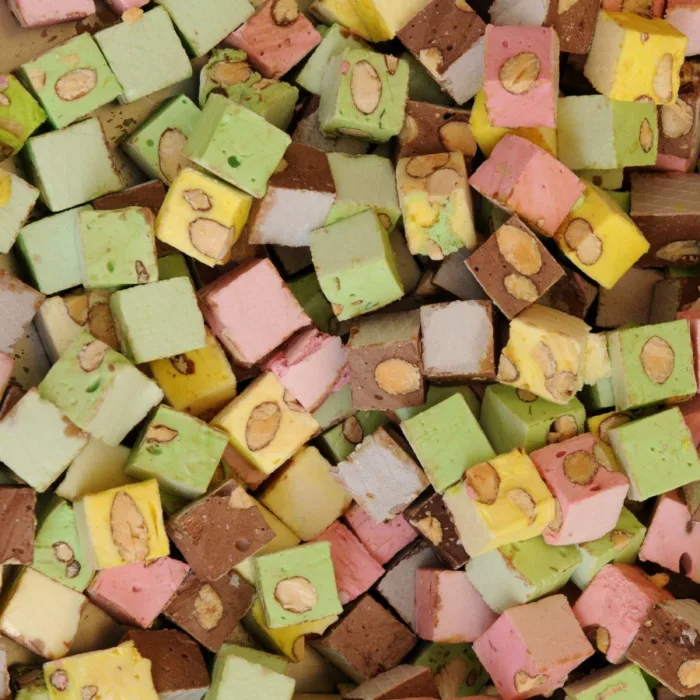

- Spain (Turrón): with its hard, crunchy turrón with whole almonds from Alicante or the soft, paste-like turrón where almonds are ground into a paste from Jijona (Xixona)
- France (Nougat): its Nougat de Montélimar is famous for its blend of almonds, honey, pistachios, and sometimes lavender or orange blossom water. The French nougat can be either white (with egg whites) or brown (with caramelized sugar for flavor).
- Philippines (Panucha): similar to torrone but often made with local ingredients like coconut milk and sesame seeds
- Middle East (Gaz): a nougat-like confection made primarily from rose water, pistachios, and almond slivers and the sap from the Gaz plant
- Latin America: Dona Pepa flavored with anise










You’ve inspired me to try making candy at home; your recipe makes it sound less scary