
Profound Teachings as an Excelent Educational Tool for Children of All Ages
Jesus’ parables are like the ultimate parenting hack, teaching valuable life lessons in a way that even the most stubborn little humans can’t resist. It’s like sneaking vegetables into their favorite mac and cheese, but instead of fiber, they’re getting a healthy dose of wisdom and compassion.


They are rich with imagery and profound, while being simple and fun at the same time. At the same time, they addressing various aspects of faith and morality. They were central to His teaching ministry and remain foundational in Christian education. This exploration below delves into some of the significant parables mentioned in the Bible, focusing on key themes and lessons they convey. Therefore, it is an important tool for you as parents to explain these beautiful stories to your children, enhancing the teachings so masterfully hidden in them.
1. The Parable of The Faithful and Wise Servant
Matthew 24:45-51; Luke 12:42-48;

Summary
In these parables, Jesus describes a servant who is given charge of his master’s household while the master is away. The faithful and wise servant diligently fulfills his duties and is rewarded upon the master’s return. In contrast, the wicked servant abuses his power and faces severe punishment when the master returns unexpectedly.
Matthew 24:45-51
- The Faithful Servant (Verses 45-47): “Who then is the faithful and wise servant, whom the master has put in charge of the servants in his household to give them their food at the proper time? It will be good for that servant whose master finds him doing so when he returns. Truly I tell you, he will put him in charge of all his possessions.”
- The Wicked Servant (Verses 48-51): “But suppose that servant is wicked and says to himself, ‘My master is staying away a long time,’ and he then begins to beat his fellow servants and to eat and drink with drunkards. The master of that servant will come on a day when he does not expect him and at an hour he is not aware of. He will cut him to pieces and assign him a place with the hypocrites, where there will be weeping and gnashing of teeth.”
Luke 12:42-48
- The Faithful and Wise Steward (Verses 42-44): “The Lord answered, ‘Who then is the faithful and wise manager, whom the master puts in charge of his servants to give them their food allowance at the proper time? It will be good for that servant whom the master finds doing so when he returns. Truly I tell you, he will put him in charge of all his possessions.'”
- The Unfaithful Servant (Verses 45-46): “But suppose the servant says to himself, ‘My master is taking a long time in coming,’ and he then begins to beat the other servants, both men and women, and to eat and drink and get drunk. The master of that servant will come on a day when he does not expect him and at an hour he is not aware of. He will cut him to pieces and assign him a place with the unbelievers.”
- Degrees of Punishment (Verses 47-48): “The servant who knows the master’s will and does not get ready or does not do what the master wants will be beaten with many blows. But the one who does not know and does things deserving punishment will be beaten with few blows. From everyone who has been given much, much will be demanded; and from the one who has been entrusted with much, much more will be asked.”
By embodying the qualities of the faithful and wise servant, believers can live lives that are pleasing to God, ready to welcome His return, and prepared to receive the rewards of their faithfulness.
- Faithfulness: Demonstrating loyalty and diligence in responsibilities.
- Accountability: Being answerable for one’s actions.
- Readiness: Staying prepared for the master’s return.
Faithful and Wise Servant (Matthew 24:45-51; Luke 12:42-48)
- Role: Entrusted with the care and management of the master’s household, symbolizing a significant position of trust.
- Actions: This servant diligently carries out his responsibilities, ensuring the household runs smoothly and other servants are well-treated.
- Reward: Upon the master’s return, the faithful servant is rewarded by being given greater responsibilities, reflecting the master’s trust in his abilities.
Wicked Servant (Matthew 24:45-51; Luke 12:42-48)
- Role: Initially holds the same position of trust and responsibility.
- Actions: The wicked servant, assuming the master’s return is far off, begins to mistreat fellow servants and indulge in excessive behavior.
- Punishment: The master returns unexpectedly and punishes the wicked servant severely, demonstrating the consequences of neglecting responsibilities and abusing power.
- Jesus’s Words on Vigilance: Jesus emphasizes the importance of being faithful and vigilant, as the timing of His return is unknown. Just as the master’s return is unexpected, so too will be the coming of the Son of Man.
- Accountability: The parable highlights that individuals are accountable for their actions, particularly those in positions of responsibility.
- Readiness: It calls for believers to live in a state of preparedness, faithfully executing their duties and living according to God’s will.
- Faithfulness in Service: The parable encourages believers to remain faithful in their service to God and others, performing their duties diligently and with integrity.
- Responsibility and Trust: It underscores the importance of being trustworthy and responsible, as these qualities will be rewarded by God.
- Consequences of Unfaithfulness: The severe punishment of the wicked servant serves as a warning against complacency, abuse of power, and neglect of duty.
- Spiritual Readiness: Followers of Jesus are urged to live each day in readiness for His return, maintaining their faith and dedication.
- Diligent Living: Believers should strive to be like the faithful servant, diligently working and caring for others, thus fulfilling the role God has entrusted to them.
- Eternal Perspective: The parable encourages an eternal perspective, focusing on living a life that honors God and prepares for His return rather than indulging in short-term, selfish pleasures.
2. The Parable of the Unmerciful Servant
Matthew 18:21-35

Summary
In this parable, Jesus tells the story of a servant who is forgiven a massive debt by his master. However, this same servant refuses to forgive a fellow servant’s much smaller debt. When the master learns of this, he punishes the unmerciful servant severely. This parable emphasizes the necessity of forgiving others as we have been forgiven by God.
Matthew 18:21-35
Peter’s Question and Jesus’s Answer (Verses 21-22):
“Then Peter came to Jesus and asked, ‘Lord, how many times shall I forgive my brother or sister who sins against me? Up to seven times?’ Jesus answered, ‘I tell you, not seven times, but seventy-seven times.'”
The Parable (Verses 23-34):
The King’s Compassion (Verses 23-27): “Therefore, the kingdom of heaven is like a king who wanted to settle accounts with his servants. As he began the settlement, a man who owed him ten thousand bags of gold was brought to him. Since he was not able to pay, the master ordered that he and his wife and his children and all that he had be sold to repay the debt. At this, the servant fell on his knees before him. ‘Be patient with me,’ he begged, ‘and I will pay back everything.’ The servant’s master took pity on him, canceled the debt and let him go.”
The Servant’s Unmerciful Actions (Verses 28-30): “But when that servant went out, he found one of his fellow servants who owed him a hundred silver coins. He grabbed him and began to choke him. ‘Pay back what you owe me!’ he demanded. His fellow servant fell to his knees and begged him, ‘Be patient with me, and I will pay it back.’ But he refused. Instead, he went off and had the man thrown into prison until he could pay the debt.”
The King’s Judgment (Verses 31-34): “When the other servants saw what had happened, they were outraged and went and told their master everything that had happened. Then the master called the servant in. ‘You wicked servant,’ he said, ‘I canceled all that debt of yours because you begged me to. Shouldn’t you have had mercy on your fellow servant just as I had on you?’ In anger his master handed him over to the jailers to be tortured, until he should pay back all he owed.”
Conclusion (Verse 35):
“This is how my heavenly Father will treat each of you unless you forgive your brother or sister from your heart.”
The parable of the Unmerciful Servant powerfully illustrates the necessity of forgiveness in the Christian life. It serves as a sobering reminder of the grace we have received and the grace we must extend to others.
- Forgiveness: Extending mercy and pardon to others.
- Mercy: Showing compassion and leniency.
- Divine Justice: God’s righteous judgment based on actions.
Context (Matthew 18:21-35)
- Peter’s Question (Verse 21): Peter asks Jesus how many times he should forgive a brother or sister who sins against him, suggesting “up to seven times.”
- Jesus’s Reply (Verse 22): Jesus responds, “I tell you, not seven times, but seventy-seven times,” indicating that forgiveness should be limitless.
The Parable (Verses 23-35)
The King and His Servants (Verses 23-24):
- King: Represents God.
- Servants: Represent people.
- Debt: The first servant owes the king ten thousand talents, an enormous, unpayable debt symbolizing the debt of sin.
Mercy and Forgiveness (Verses 25-27):
- The servant, unable to repay, begs for patience.
- The king, moved by compassion, cancels the debt entirely, illustrating God’s immense mercy and forgiveness towards us.
The Unmerciful Servant (Verses 28-30):
- The forgiven servant encounters a fellow servant who owes him a hundred silver coins, a much smaller debt.
- Despite being shown mercy, the first servant demands repayment and has the fellow servant thrown into prison when he cannot pay.
Judgment (Verses 31-34):
- Other servants report the unmerciful servant’s actions to the king.
- The king confronts the unmerciful servant, condemns his lack of mercy, and punishes him by handing him over to the jailers to be tortured until he can repay all he owes.
Conclusion (Verse 35):
Jesus concludes, “This is how my heavenly Father will treat each of you unless you forgive your brother or sister from your heart.”
- Forgiveness as a Command: Jesus teaches that forgiveness is not optional but a command for His followers.
- Reciprocal Mercy: Just as we have received mercy and forgiveness from God, we are expected to extend the same to others.
- Severe Consequences: The parable warns of the severe consequences of failing to forgive others, highlighting the importance of heartfelt forgiveness.
- Unconditional Forgiveness: We are to forgive others without keeping count, just as God’s forgiveness towards us is boundless.
- Reflection of God’s Character: Forgiving others is a reflection of God’s character in us, demonstrating His love and mercy.
- Internal Transformation: True forgiveness must come from the heart, not just as an outward act but as a genuine, internal transformation.
- Imitate Divine Forgiveness: Believers are called to imitate God’s forgiveness in their daily interactions.
- Heartfelt Forgiveness: The emphasis on forgiving “from your heart” points to the need for sincere and deep-rooted forgiveness.
- Community Impact: Practicing forgiveness strengthens community bonds and fosters a spirit of grace and mercy among believers.
The parable of the Unmerciful Servant powerfully illustrates the necessity of forgiveness in the Christian life. It serves as a sobering reminder of the grace we have received and the grace we must extend to others.
3. The Parable of the Sower
Matthew 13:1-23

Summary
The Parable of the Sower is one of Jesus’s most well-known parables. It describes a sower scattering seeds on four types of soil, each representing different responses to the Word of God. The outcomes vary based on the soil’s condition, illustrating how different hearts receive and nurture faith.
Matthew 13:1-23
Telling the Parable (Verses 1-9):
“That same day Jesus went out of the house and sat by the lake. Such large crowds gathered around him that he got into a boat and sat in it, while all the people stood on the shore.
Then he told them many things in parables, saying: ‘A farmer went out to sow his seed. As he was scattering the seed, some fell along the path, and the birds came and ate it up. Some fell on rocky places, where it did not have much soil. It sprang up quickly, because the soil was shallow. But when the sun came up, the plants were scorched, and they withered because they had no root. Other seed fell among thorns, which grew up and choked the plants. Still other seed fell on good soil, where it produced a crop—a hundred, sixty or thirty times what was sown. Whoever has ears, let them hear.'”
Explanation to the Disciples (Verses 18-23):
“‘Listen then to what the parable of the sower means: When anyone hears the message about the kingdom and does not understand it, the evil one comes and snatches away what was sown in their heart. This is the seed sown along the path.
The seed falling on rocky ground refers to someone who hears the word and at once receives it with joy. But since they have no root, they last only a short time. When trouble or persecution comes because of the word, they quickly fall away. The seed falling among the thorns refers to someone who hears the word, but the worries of this life and the deceitfulness of wealth choke the word, making it unfruitful. But the seed falling on good soil refers to someone who hears the word and understands it. This is the one who produces a crop, yielding a hundred, sixty or thirty times what was sown.'”
Mark 4:1-20
Telling the Parable (Verses 1-9):
“Again Jesus began to teach by the lake. The crowd that gathered around him was so large that he got into a boat and sat in it out on the lake, while all the people were along the shore at the water’s edge. He taught them many things by parables, and in his teaching said: ‘Listen! A farmer went out to sow his seed.
As he was scattering the seed, some fell along the path, and the birds came and ate it up.
Some fell on rocky places, where it did not have much soil. It sprang up quickly, because the soil was shallow. But when the sun came up, the plants were scorched, and they withered because they had no root.
Other seed fell among thorns, which grew up and choked the plants, so that they did not bear grain. Still other seed fell on good soil. It came up, grew and produced a crop, some multiplying thirty, some sixty, some a hundred times.’ Then Jesus said, ‘Whoever has ears to hear, let them hear.'”
Explanation to the Disciples (Verses 13-20):
“Then Jesus said to them, ‘Don’t you understand this parable? How then will you understand any parable? The farmer sows the word. Some people are like seed along the path, where the word is sown. As soon as they hear it, Satan comes and takes away the word that was sown in them.
Others, like seed sown on rocky places, hear the word and at once receive it with joy. But since they have no root, they last only a short time. When trouble or persecution comes because of the word, they quickly fall away.
Still others, like seed sown among thorns, hear the word; but the worries of this life, the deceitfulness of wealth and the desires for other things come in and choke the word, making it unfruitful. Others, like seed sown on good soil, hear the word, accept it, and produce a crop—some thirty, some sixty, some a hundred times what was sown.'”
Luke 8:4-15
Telling the Parable (Verses 4-8):
“While a large crowd was gathering and people were coming to Jesus from town after town, he told this parable: ‘A farmer went out to sow his seed. As he was scattering the seed, some fell along the path; it was trampled on, and the birds ate it up. Some fell on rocky ground, and when it came up, the plants withered because they had no moisture. Other seed fell among thorns, which grew up with it and choked the plants. Still other seed fell on good soil. It came up and yielded a crop, a hundred times more than was sown.’ When he said this, he called out, ‘Whoever has ears to hear, let them hear.'”
Explanation to the Disciples (Verses 11-15):
“‘This is the meaning of the parable: The seed is the word of God. Those along the path are the ones who hear, and then the devil comes and takes away the word from their hearts, so that they may not believe and be saved. Those on the rocky ground are the ones who receive the word with joy when they hear it, but they have no root. They believe for a while, but in the time of testing they fall away. The seed that fell among thorns stands for those who hear, but as they go on their way they are choked by life’s worries, riches and pleasures, and they do not mature. But the seed on good soil stands for those with a noble and good heart, who hear the word, retain it, and by persevering produce a crop.'”
- Reception of God’s Word: Different responses to hearing the gospel.
- Spiritual Growth: The varying outcomes based on one’s receptivity to God’s Word.
- Fruitfulness: The manifestation of faith through actions and perseverance.
Context (Matthew 13:1-23; Mark 4:1-20; Luke 8:4-15)
- Setting: Jesus tells this parable to a large crowd by the sea, using it to teach about the kingdom of God.
- Interpretation: Jesus later explains the parable to His disciples, revealing the deeper spiritual meaning.
The Parable
The Sower and the Seed:
- Sower: Represents Jesus or anyone who proclaims God’s Word.
- Seed: Represents the Word of God.
The Four Types of Soil:
- Path (Matthew 13:4, 19; Mark 4:4, 15; Luke 8:5, 12):
- Description: Seed falls along the path and is trampled or eaten by birds.
- Interpretation: Represents those who hear the Word but do not understand it. The evil one comes and snatches away what was sown in their hearts.
- Rocky Ground (Matthew 13:5-6, 20-21; Mark 4:5-6, 16-17; Luke 8:6, 13):
- Description: Seed falls on rocky places where there is little soil. It springs up quickly but withers under the sun because it has no root.
- Interpretation: Represents those who receive the Word with joy but have no root. They believe for a while, but fall away when trouble or persecution arises.
- Thorns (Matthew 13:7, 22; Mark 4:7, 18-19; Luke 8:7, 14):
- Description: Seed falls among thorns, which grow up and choke the plants.
- Interpretation: Represents those who hear the Word, but their faith is choked by life’s worries, riches, and pleasures. They do not mature and bear fruit.
- Good Soil (Matthew 13:8, 23; Mark 4:8, 20; Luke 8:8, 15):
- Description: Seed falls on good soil and produces a crop yielding thirty, sixty, or even a hundred times what was sown.
- Interpretation: Represents those with a noble and good heart, who hear the Word, retain it, and by persevering, produce a fruitful harvest.
- Receptivity Matters: The condition of one’s heart determines how the Word of God is received and nurtured.
- Fruitfulness: Genuine faith is evidenced by perseverance and fruitful living.
- Understanding and Retention: Spiritual growth requires understanding, retaining, and acting on God’s Word.
- Prepare Your Heart: Believers are encouraged to cultivate a receptive and persevering heart to nurture their faith.
- Overcome Obstacles: Be aware of the obstacles (e.g., distractions, superficial faith, and worldly cares) that hinder spiritual growth.
- Bear Fruit: True discipleship is marked by bearing fruit, demonstrating the transformative power of the gospel in one’s life.
- Self-Examination: Reflect on the condition of your heart and how you respond to God’s Word.
- Cultivate Good Soil: Engage in practices that deepen your understanding and commitment to the faith.
- Persevere in Faith: Recognize the challenges and distractions that can impede your spiritual growth, and seek to overcome them.
4. The Parable of the Wheat and the Tares
Matthew 13:24-30; 13:36-43
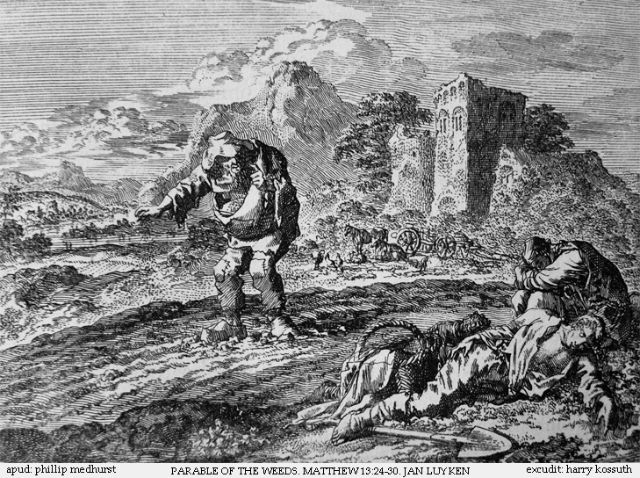
Summary
The Parable of the Wheat and the Tares, also known as the Parable of the Weeds, describes a farmer who sows good seed in his field. An enemy then sows weeds among the wheat. Both grow together until the harvest, when the weeds are separated and burned, and the wheat is gathered into the barn. Jesus uses this parable to teach about the presence of evil in the world and the final judgment.
Matthew 13:24-30; 13:36-43
Telling the Parable (Verses 24-30):
“Jesus told them another parable: ‘The kingdom of heaven is like a man who sowed good seed in his field. But while everyone was sleeping, his enemy came and sowed weeds among the wheat, and went away. When the wheat sprouted and formed heads, then the weeds also appeared. The owner’s servants came to him and said, “Sir, didn’t you sow good seed in your field? Where then did the weeds come from?” “An enemy did this,” he replied. The servants asked him, “Do you want us to go and pull them up?” “No,” he answered, “because while you are pulling the weeds, you may uproot the wheat with them. Let both grow together until the harvest. At that time I will tell the harvesters: First collect the weeds and tie them in bundles to be burned; then gather the wheat and bring it into my barn.”‘”
Explanation to the Disciples (Verses 36-43):
“Then he left the crowd and went into the house. His disciples came to him and said, ‘Explain to us the parable of the weeds in the field.’ He answered, ‘The one who sowed the good seed is the Son of Man. The field is the world, and the good seed stands for the people of the kingdom. The weeds are the people of the evil one, and the enemy who sows them is the devil. The harvest is the end of the age, and the harvesters are angels.
As the weeds are pulled up and burned in the fire, so it will be at the end of the age. The Son of Man will send out his angels, and they will weed out of his kingdom everything that causes sin and all who do evil. They will throw them into the blazing furnace, where there will be weeping and gnashing of teeth. Then the righteous will shine like the sun in the kingdom of their Father. Whoever has ears, let them hear.'”
- Good and Evil: The coexistence of righteous and wicked people in the world.
- Divine Judgment: The ultimate separation of the righteous and the wicked.
- End of the Age: The final judgment and the establishment of God’s kingdom.
Context (Matthew 13:24-30, 36-43)
- Setting: Jesus tells this parable to the crowd, and later explains it to His disciples in private.
- Interpretation: Jesus provides a detailed explanation of the parable’s meaning, emphasizing the future judgment.
The Parable
1. The Sower of the Good Seed and the Enemy
- Sower of the Good Seed: Represents Jesus, the Son of Man, who sows the good seed (the children of the kingdom).
- Enemy: Represents the devil, who sows the tares (the children of the evil one) among the wheat.
2. The Field, the Wheat, and the Tares
- Field (Matthew 13:24, 38):
- Description: A man sows good seed in his field, but while everyone is sleeping, his enemy comes and sows tares among the wheat.
- Interpretation: The field represents the world where the good seed (the children of the kingdom) and the tares (the children of the evil one) coexist until the harvest.
- Wheat and Tares (Matthew 13:25-26, 37-39):
- Description: As the wheat sprouts and forms heads, the tares also appear.
- Interpretation: The wheat represents the children of the kingdom. The tares represent the children of the evil one, growing among the wheat and appearing similar until maturity.
3. The Servants’ Question and the Master’s Response
- Servants’ Question (Matthew 13:27-28):
- Description: The servants ask the sower if he wants them to go and pull up the tares.
- Interpretation: The servants’ concern reflects the believers’ awareness of evil in the world and their desire to remove it immediately.
- Master’s Response (Matthew 13:28-30, 39-41):
- Description: The master tells the servants to let both grow together until the harvest. At that time, he will instruct the harvesters to first collect the tares and bind them in bundles to be burned, and then to gather the wheat into his barn.
- Interpretation: Jesus teaches patience and the inevitability of final judgment. The harvest symbolizes the end of the age when the righteous and the wicked will be separated. The righteous will be gathered into the kingdom of their Father, while the wicked will face judgment and destruction.
4. The Harvest and the Harvesters
- Harvest and Harvesters (Matthew 13:30, 39-43):
- Description: At harvest time, the reapers (angels) will collect the tares and burn them, while gathering the wheat into the barn.
- Interpretation: The harvest represents the end of the age. The angels will execute judgment, separating the righteous from the wicked. The righteous will shine like the sun in the kingdom of their Father, while the wicked will be cast into the blazing furnace, where there will be weeping and gnashing of teeth.
- Coexistence: Good and evil will coexist in the world until the end of the age.
- Patience: Believers are to be patient and not attempt to prematurely judge or remove the wicked, as it could harm the righteous.
- Final Judgment: There will be a final separation at the end of the age, where the wicked will face punishment, and the righteous will be rewarded.
- Trust in Divine Justice: Believers should trust that God will ultimately judge and separate the righteous from the wicked.
- Persevere in Faith: Despite the presence of evil, believers are encouraged to grow and remain faithful.
- Eternal Perspective: Keep an eternal perspective, knowing that justice will prevail at the end of the age.
- Living Among Weeds: Understand the reality of living among evil and unrighteousness but maintain a focus on personal growth and righteousness.
- God’s Timing: Trust in God’s timing for judgment and avoid taking matters into your own hands.
- Shine Like the Sun: Aspire to shine like the righteous in the kingdom of God, reflecting His glory and righteousness.
5. The Parable of the Prodigal Son
Luke 15:11-32

Summary
In this parable, a younger son demands his inheritance early, leaves home, and squanders his wealth in reckless living. When he faces severe hardship, he decides to return to his father, seeking forgiveness. The father joyfully welcomes him back, but the older brother resents the celebration for his wayward sibling. Jesus uses this parable to illustrate God’s joy over a repentant sinner and to challenge self-righteous attitudes.
Luke 15:11-32
The Younger Son’s Journey (verses 1-17)
1 Jesus continued: “There was a man who had two sons. 2 The younger one said to his father, ‘Father, give me my share of the estate.’ So he divided his property between them. 3 Not long after that, the younger son got together all he had, set off for a distant country and there squandered his wealth in wild living. 4 After he had spent everything, there was a severe famine in that whole country, and he began to be in need.
5 So he went and hired himself out to a citizen of that country, who sent him to his fields to feed pigs. 6 He longed to fill his stomach with the pods that the pigs were eating, but no one gave him anything. 7 When he came to his senses, he said, ‘How many of my father’s hired servants have food to spare, and here I am starving to death! 8 I will set out and go back to my father and say to him: Father, I have sinned against heaven and against you. 9 I am no longer worthy to be called your son; make me like one of your hired servants.’ 10 So he got up and went to his father.
11 But while he was still a long way off, his father saw him and was filled with compassion for him; he ran to his son, threw his arms around him and kissed him. 12 The son said to him, ‘Father, I have sinned against heaven and against you. I am no longer worthy to be called your son.’
13 But the father said to his servants, ‘Quick! Bring the best robe and put it on him. Put a ring on his finger and sandals on his feet. 14 Bring the fattened calf and kill it. Let’s have a feast and celebrate. 15 For this son of mine was dead and is alive again; he was lost and is found.’ So they began to celebrate.
16 Meanwhile, the older son was in the field. When he came near the house, he heard music and dancing. 17 So he called one of the servants and asked him what was going on.
The Older Son’s Response (verses 18-30)
18 ‘Your brother has come,’ he replied, ‘and your father has killed the fattened calf because he has him back safe and sound.’
19 The older brother became angry and refused to go in. So his father went out and pleaded with him. 20 But he answered his father, ‘Look! All these years I’ve been slaving for you and never disobeyed your orders. Yet you never gave me even a young goat so I could celebrate with my friends. 21 But when this son of yours who has squandered your property with prostitutes comes home, you kill the fattened calf for him!’
22 ‘My son,’ the father said, ‘you are always with me, and everything I have is yours. 23 But we had to celebrate and be glad, because this brother of yours was dead and is alive again; he was lost and is found.'”
- Repentance: The return of the wayward son symbolizes repentance and seeking forgiveness.
- Forgiveness: The father’s unconditional acceptance and forgiveness highlight God’s grace.
- God’s Unconditional Love: The father’s love represents God’s boundless love for His children.
- Self-Righteousness: The older brother’s reaction exposes the dangers of self-righteousness and lack of compassion.
Context (Luke 15:11-32)
Setting: Jesus tells this parable to a mixed audience, including tax collectors, sinners, Pharisees, and teachers of the law. It is part of a trilogy of parables in Luke 15, all emphasizing God’s joy over repentance: the Lost Sheep, the Lost Coin, and the Prodigal Son.
The Parable
1. The Father and His Two Sons
- Father: Represents God, characterized by His boundless love, grace, and forgiveness.
- Younger Son: Represents the sinner who turns away from God but eventually seeks repentance.
- Elder Son: Represents the self-righteous, who struggle with forgiveness and understanding God’s grace.
2. The Younger Son’s Journey
- Request and Departure (Luke 15:11-13):
- Description: The younger son asks his father for his share of the inheritance, leaves home, and squanders his wealth in wild living in a distant country.
- Interpretation: Represents the sinner’s rebellion against God, choosing self-indulgence and independence, leading to spiritual and moral decay.
- Fall into Hardship (Luke 15:14-16):
- Description: After spending everything, a severe famine hits the country, and the younger son finds himself in dire need. He takes a job feeding pigs and longs to eat the pods the pigs are eating.
- Interpretation: Illustrates the emptiness and degradation that come from living apart from God, symbolizing the consequences of sin.
- Realization and Return (Luke 15:17-19):
- Description: Coming to his senses, the younger son decides to return to his father, acknowledging his sin and planning to ask to be made a servant.
- Interpretation: Represents the sinner’s recognition of their need for repentance and decision to return to God, seeking forgiveness and restoration.
3. The Father’s Response
- Compassion and Forgiveness (Luke 15:20-24):
- Description: While the younger son is still a long way off, his father sees him, is filled with compassion, runs to him, embraces him, and kisses him. The father orders his servants to bring the best robe, a ring, and sandals, and to prepare a feast to celebrate his return.
- Interpretation: Reflects God’s readiness to forgive, His joy in the sinner’s repentance, and His unconditional love. The robe, ring, and sandals symbolize full restoration and acceptance.
4. The Elder Son’s Reaction
- Anger and Resentment (Luke 15:25-30):
- Description: The elder son hears the celebration and becomes angry, refusing to join. He confronts his father, expressing resentment over never receiving such a celebration despite his years of faithful service.
- Interpretation: Represents the self-righteous who struggle with understanding God’s grace towards repentant sinners. It highlights the dangers of pride and a lack of compassion for those who return to God.
- Father’s Reassurance (Luke 15:31-32):
- Description: The father reassures the elder son that everything he has is his, but it is necessary to celebrate because the younger brother was dead and is alive again; he was lost and is found.
- Interpretation: Emphasizes that God’s grace and joy in a sinner’s repentance do not diminish His love for the righteous. It calls for the righteous to share in the joy of others’ redemption and forgiveness.
- Repentance and Forgiveness: This parable emphasizes the importance of repentance and the joy that comes with forgiveness.
- God’s Grace: God’s love and grace are unconditional, welcoming back sinners with open arms.
- Self-Righteousness: It warns against self-righteousness and encourages compassion and understanding toward those who have strayed.
- Celebration of Redemption: The joy in heaven over one sinner who repents should be mirrored by believers on earth.
- Unconditional Love: Like the father in the parable, believers are called to show unconditional love and forgiveness.
- Avoid Self-Righteousness: Do not let self-righteous attitudes prevent you from rejoicing over the repentance of others.
- Embrace Repentance: Acknowledge and celebrate the return of those who seek forgiveness and restoration.
- Welcoming the Lost: Be ready to welcome back those who have strayed, just as the father welcomed his lost son.
- God’s Perspective: Understand and adopt God’s perspective on forgiveness and grace.
- Self-Examination: Examine your own attitudes for any signs of self-righteousness or lack of compassion.
6. The Parable of the Lost Sheep
Matthew 18:12-14; Luke 15:3-7

Summary
The Parable of the Lost Sheep illustrates God’s relentless pursuit of lost individuals and the joy in heaven over their repentance. A shepherd leaves his ninety-nine sheep to find the one that is lost. When he finds it, he rejoices more over the found sheep than over the ninety-nine who did not stray. This parable underscores the immense value God places on each individual and the celebration that follows a sinner’s return.
Matthew 18:12-14
“What do you think? If a man owns a hundred sheep, and one of them wanders away, will he not leave the ninety-nine on the hills and go to look for the one that wandered off? And if he finds it, truly I tell you, he is happier about that one sheep than about the ninety-nine that did not wander off. In the same way, your Father in heaven is not willing that any of these little ones should perish.”
Luke 15:3-7
“Then Jesus told them this parable: ‘Suppose one of you has a hundred sheep and loses one of them. Doesn’t he leave the ninety-nine in the open country and go after the lost sheep until he finds it? And when he finds it, he joyfully puts it on his shoulders and goes home. Then he calls his friends and neighbors together and says, “Rejoice with me; I have found my lost sheep.” I tell you that in the same way there will be more rejoicing in heaven over one sinner who repents than over ninety-nine righteous persons who do not need to repent.'”
- God’s Love for the Lost: Demonstrates God’s deep concern and love for those who have gone astray.
- Repentance and Rejoicing: Emphasizes the joy in heaven over one sinner who repents.
- Individual Worth: Each person is precious and valuable to God.
Context (Matthew 18:12-14; Luke 15:3-7)
Setting: Jesus tells this parable to illustrate God’s love for sinners and the joy in heaven over their repentance. In Matthew, it is part of a discourse on humility and care for the “little ones.” In Luke, it is addressed to Pharisees and teachers of the law who criticize Jesus for associating with sinners.
The Parable
1. The Shepherd and the Sheep
- Shepherd: Represents Jesus or God, characterized by His diligence and love in seeking out the lost.
- Sheep: Represents individuals, particularly those who have strayed away from God or who are considered lost due to their sins or circumstances.
2. The Lost Sheep and the Shepherd’s Search
- The Lost Sheep (Matthew 18:12; Luke 15:4):
- Description: A shepherd has a hundred sheep, and one of them goes missing. The shepherd leaves the ninety-nine sheep in the open country or hills and goes after the lost one.
- Interpretation: The lost sheep symbolizes the individual who strays from God. The shepherd’s willingness to leave the ninety-nine represents God’s proactive pursuit of each lost soul, demonstrating His concern and dedication to reclaiming the lost.
- The Search and Rescue (Matthew 18:12; Luke 15:4-5):
- Description: The shepherd searches for the lost sheep until he finds it. Upon finding it, he joyfully places it on his shoulders.
- Interpretation: The shepherd’s search signifies God’s relentless effort to bring back those who are lost. The joy of finding and carrying the sheep represents the celebration and care God shows when a sinner repents and returns to Him.
3. The Joyful Return
- The Celebration (Matthew 18:13; Luke 15:5-7):
- Description: When the shepherd returns with the lost sheep, he calls his friends and neighbors together to celebrate, saying, “Rejoice with me; I have found my lost sheep.”
- Interpretation: The shepherd’s celebration with friends and neighbors symbolizes the joy in heaven over one sinner who repents. It underscores the immense value God places on each individual and the collective joy in the spiritual community over their restoration.
4. The Ninety-Nine and the One
- The Perspective (Matthew 18:14; Luke 15:7):
- Description: In the parable, Jesus emphasizes that there is more rejoicing in heaven over one sinner who repents than over ninety-nine righteous persons who do not need to repent.
- Interpretation: This statement highlights the importance of individual redemption and God’s inclusive love for all, even those who may seem insignificant or unworthy. It calls for the community to value the lost and to participate in the joy of their return.
- God’s Pursuit: The parable illustrates God’s proactive and loving pursuit of those who are lost.
- Joy in Repentance: There is immense joy in heaven over the repentance of even one sinner.
- Value of Individuals: Each person is of great value to God, and He does not want any to perish.
- Compassion: Like the shepherd, believers should have compassion and concern for those who are lost.
- Rejoice in Repentance: Celebrate and support those who return to the faith.
- Seek the Lost: Actively seek out those who have strayed and offer them guidance and support.
- Imitate God’s Love: Show relentless love and care for those who have gone astray, just as God does.
- Celebrate Repentance: Rejoice and welcome back those who repent and return to the faith.
- Value Each Person: Recognize the immense worth of each individual in God’s eyes and strive to reach out to the lost.
7. The Parable of the Mustard Seed
Matthew 13:31-32; Mark 4:30-32; Luke 13:18-19

Summary
The Parable of the Mustard Seed is one of Jesus’s short stories, describing the Kingdom of Heaven as starting from the smallest seed and growing into a large tree. This parable emphasizes the idea that even the smallest beginnings, when nurtured by faith, can lead to great and significant results. It reflects how the Kingdom of God starts from humble origins but expands to offer shelter and benefits to many.
Matthew 13:31-32
“He told them another parable: ‘The kingdom of heaven is like a mustard seed, which a man took and planted in his field. Though it is the smallest of all seeds, yet when it grows, it is the largest of garden plants and becomes a tree, so that the birds come and perch in its branches.'”
Mark 4:30-32
“Again he said, ‘What shall we say the kingdom of God is like, or what parable shall we use to describe it? It is like a mustard seed, which is the smallest of all seeds on earth. Yet when planted, it grows and becomes the largest of all garden plants, with such big branches that the birds can perch in its shade.'”
Luke 13:18-19
“Then Jesus asked, ‘What is the kingdom of God like? What shall I compare it to? It is like a mustard seed, which a man took and planted in his garden. It grew and became a tree, and the birds perched in its branches.'”
- Growth of God’s Kingdom: Illustrates how the Kingdom of Heaven starts small but grows into something significant.
- Faith and Small Beginnings: Highlights the potential of small acts of faith to produce great outcomes.
- Divine Transformation: Demonstrates God’s power to transform humble beginnings into something majestic.
Context (Matthew 13:31-32; Mark 4:30-32; Luke 13:18-19)
Setting:
Jesus tells this parable to a crowd, using everyday life and natural imagery to explain divine truths. It is part of a series of parables explaining the nature of God’s Kingdom.
Audience:
Followers of Jesus, including the disciples and those curious about his teachings.
The Parable
1. The Sower and the Mustard Seed
- Sower: Represents Jesus or anyone who spreads the message of the kingdom of God.
- Mustard Seed: Represents the kingdom of God, starting small but growing significantly.
2. The Growth of the Mustard Seed
- Planting and Growth (Matthew 13:31-32; Mark 4:31-32; Luke 13:19):
- Description: A man plants a mustard seed in his field or garden. Although the mustard seed is the smallest of all seeds, it grows into the largest of garden plants or a large tree.
- Interpretation: The mustard seed symbolizes the small and seemingly insignificant beginnings of the kingdom of God. Despite its small start, it grows extensively, signifying the expansive and transformative power of God’s kingdom. This growth reflects how the kingdom starts with Jesus’ ministry and the faith of a few but expands to encompass many.
3. The Mature Mustard Plant
- Size and Influence (Matthew 13:32; Mark 4:32; Luke 13:19):
- Description: The mustard plant grows into a large plant or tree, providing branches where birds can perch.
- Interpretation: The large plant represents the full manifestation of the kingdom of God, offering refuge and shelter. The birds nesting in the branches symbolize people from all nations finding rest and shelter within the kingdom, highlighting its inclusive nature and universal reach.
- Small Beginnings: The mustard seed, known for being very small, represents humble beginnings. The Kingdom of Heaven started with Jesus and a few disciples but has grown to encompass billions of followers.
- Exponential Growth: The parable highlights the potential for exponential growth. From something seemingly insignificant, great things can come.
- Shelter and Inclusion: The large tree providing shelter for birds symbolizes the inclusiveness and provision of God’s Kingdom.
- Value of Small Acts: Small acts of faith, kindness, and service can have a significant impact. Even the smallest contributions to God’s work can lead to remarkable outcomes.
- Faith in Growth: Trust in God’s power to grow and expand the good work started in small ways. Have faith that efforts in God’s name will bear fruit beyond initial expectations.
- Plant Seeds of Faith: Encourage believers to sow seeds of faith through small, faithful actions.
- Trust in God’s Timing: Understand that growth in God’s Kingdom may not be immediate, but it is sure and significant.
- Be Part of the Growth: Participate actively in the work of the Kingdom, knowing that even small efforts contribute to a larger divine plan.
8. The Parable of the Wise and Foolish Builders
Matthew 7:24-27; Luke 6:46-49

Summary
The Parable of the Wise and Foolish Builders, one of Jesus’s short stories, illustrates the difference between those who hear His words and act on them and those who hear His words but do not act. The wise builder constructs his house on a rock, providing a stable foundation, while the foolish builder constructs his house on sand, leading to destruction when storms come.
Matthew 7:24-27
“Therefore everyone who hears these words of mine and puts them into practice is like a wise man who built his house on the rock. The rain came down, the streams rose, and the winds blew and beat against that house; yet it did not fall, because it had its foundation on the rock. But everyone who hears these words of mine and does not put them into practice is like a foolish man who built his house on sand. The rain came down, the streams rose, and the winds blew and beat against that house, and it fell with a great crash.”
Luke 6:46-49
“Why do you call me, ‘Lord, Lord,’ and do not do what I say? As for everyone who comes to me and hears my words and puts them into practice, I will show you what they are like. They are like a man building a house, who dug down deep and laid the foundation on rock. When a flood came, the torrent struck that house but could not shake it, because it was well built. But the one who hears my words and does not put them into practice is like a man who built a house on the ground without a foundation. The moment the torrent struck that house, it collapsed and its destruction was complete.”
- Obedience to Jesus’s Words: The parable emphasizes the importance of not only hearing but also acting upon Jesus’s teachings.
- Foundation of Faith: Highlights the importance of building one’s life on a strong foundation, which is Jesus’s teachings.
- Stability and Resilience: Demonstrates how a solid foundation in faith leads to resilience in the face of life’s challenges.
Context (Matthew 7:24-27; Luke 6:46-49)
Setting:
Jesus shares this parable as part of His teachings, often to large crowds, during His earthly ministry.
Audience:
Followers of Jesus, including the disciples, and those seeking to understand His teachings.
The Parable
1. The Wise Builder and the Rock
- Wise Builder: Represents those who hear Jesus’ teachings and put them into practice.
- Rock: Represents the solid foundation of Jesus’ teachings and obedience to God’s Word.
2. The Wise Builder’s Construction
- Building on the Rock (Matthew 7:24-25; Luke 6:47-48):
- Description: The wise builder constructs his house on the rock. When rain comes down, streams rise, and winds blow and beat against the house, it does not fall because it has its foundation on the rock.
- Interpretation: Building on the rock symbolizes a life built on Jesus’ teachings and obedience to them. The rock provides stability and strength, ensuring the house stands firm in the face of life’s trials and challenges. This represents the enduring and steadfast faith of those who live according to God’s Word.
3. The Foolish Builder and the Sand
- Foolish Builder: Represents those who hear Jesus’ teachings but do not put them into practice.
- Sand: Represents an unstable foundation, characterized by disobedience and a lack of adherence to Jesus’ teachings.
4. The Foolish Builder’s Construction
- Building on the Sand (Matthew 7:26-27; Luke 6:49):
- Description: The foolish builder constructs his house on the sand. When rain comes down, streams rise, and winds blow and beat against the house, it falls with a great crash because it has its foundation on the sand.
- Interpretation: Building on the sand symbolizes a life not rooted in Jesus’ teachings. The sand represents instability and vulnerability to life’s difficulties. When troubles come, a life built on disobedience and neglect of God’s Word collapses, illustrating the devastating consequences of ignoring Jesus’ instructions.
- God’s Pursuit: The parable illustrates God’s proactive and loving pursuit of those who are lost.
- Joy in Repentance: There is immense joy in heaven over the repentance of even one sinner.
- Value of Individuals: Each person is of great value to God, and He does not want any to perish.
- Compassion: Like the shepherd, believers should have compassion and concern for those who are lost.
- Rejoice in Repentance: Celebrate and support those who return to the faith.
- Seek the Lost: Actively seek out those who have strayed and offer them guidance and support.
- Imitate God’s Love: Show relentless love and care for those who have gone astray, just as God does.
- Celebrate Repentance: Rejoice and welcome back those who repent and return to the faith.
- Value Each Person: Recognize the immense worth of each individual in God’s eyes and strive to reach out to the lost.
9. The Parable of the Talents
Matthew 25:14-30

Summary
The Parable of the Talents, a significant story among Jesus’s parables, illustrates the importance of using the gifts and resources that God entrusts to individuals. The parable highlights the different ways servants manage their master’s wealth and the resulting consequences.
The Master’s Trust and the Servants’ Actions (Matthew 25:14-18)
14 “Again, it will be like a man going on a journey, who called his servants and entrusted his wealth to them.
15 To one he gave five bags of gold, to another two bags, and to another one bag, each according to his ability. Then he went on his journey.
16 The man who had received five bags of gold went at once and put his money to work and gained five bags more.
17 So also, the one with two bags of gold gained two more.
18 But the man who had received one bag went off, dug a hole in the ground and hid his master’s money.
The Master’s Return and the Servants’ Accountability (Matthew 25:19-30)
19 “After a long time the master of those servants returned and settled accounts with them.
20 The man who had received five bags of gold brought the other five. ‘Master,’ he said, ‘you entrusted me with five bags of gold. See, I have gained five more.’
21 “His master replied, ‘Well done, good and faithful servant! You have been faithful with a few things; I will put you in charge of many things. Come and share your master’s happiness!’
22 “The man with two bags of gold also came. ‘Master,’ he said, ‘you entrusted me with two bags of gold; see, I have gained two more.’
23 “His master replied, ‘Well done, good and faithful servant! You have been faithful with a few things; I will put you in charge of many things. Come and share your master’s happiness!’
24 “Then the man who had received one bag of gold came. ‘Master,’ he said, ‘I knew that you are a hard man, harvesting where you have not sown and gathering where you have not scattered seed.
25 So I was afraid and went out and hid your gold in the ground. See, here is what belongs to you.’
26 “His master replied, ‘You wicked, lazy servant! So you knew that I harvest where I have not sown and gather where I have not scattered seed?
27 Well then, you should have put my money on deposit with the bankers, so that when I returned I would have received it back with interest.
28 “‘So take the bag of gold from him and give it to the one who has ten bags.
29 For whoever has will be given more, and they will have an abundance. Whoever does not have, even what they have will be taken from them.
30 And throw that worthless servant outside, into the darkness, where there will be weeping and gnashing of teeth.’
- Stewardship: The responsible management of resources entrusted to individuals.
- Accountability: The expectation that individuals will be answerable for their use of what has been given to them.
- Faithfulness: Demonstrating loyalty and diligence in fulfilling one’s responsibilities.
- Judgment and Reward: The consequences of one’s actions, whether positive or negative.
Context (Matthew 25:14-30)
- Setting: Jesus tells this parable as part of the Olivet Discourse, which includes teachings about the end times and the Kingdom of Heaven.
- Audience: Jesus’s disciples and followers who seek to understand the nature of the Kingdom of Heaven and the expectations for its citizens.
The Parable
Entrustment of Talents:
- A man (the master) going on a journey entrusts his wealth to his servants. He gives each servant a different number of talents (a large sum of money), according to their ability: five talents to one, two talents to another, and one talent to the third.
Actions of the Servants:
- The servant with five talents trades with them and gains five more.
- The servant with two talents also gains two more.
- The servant with one talent, however, digs a hole and hides his master’s money.
The Master’s Return and Accounting:
- After a long time, the master returns and settles accounts with his servants.
- The servants who doubled their talents are praised and rewarded. The master says, “Well done, good and faithful servant! You have been faithful with a few things; I will put you in charge of many things. Come and share your master’s happiness!”
- The servant with one talent, who hid it out of fear, returns it without increase. He is reprimanded as wicked and lazy. The master orders that the talent be taken from him and given to the servant with ten talents, and the unprofitable servant is cast into outer darkness where there is weeping and gnashing of teeth.
- Stewardship and Responsibility: Believers are entrusted with various gifts, resources, and opportunities by God and are expected to use them wisely and productively.
- Accountability: Individuals will be held accountable for how they manage what has been entrusted to them.
- Faithfulness: Those who are faithful with little will be given more responsibilities and greater rewards.
- Judgment: Neglecting one’s responsibilities and failing to use God-given talents results in severe consequences.
- Use of Talents: Encourages believers to actively use their God-given abilities and resources to serve God and others.
- Preparation for Accountability: Reminds believers that they will be accountable for their actions and the use of their gifts.
- Faithfulness in Small Things: Highlights that faithfulness in small responsibilities leads to greater opportunities and blessings.
- Consequences of Inaction: Warns against laziness and fear that lead to inaction and the eventual loss of entrusted gifts.
- Embrace Responsibility: Urges believers to recognize their responsibilities and diligently work to fulfill them.
- Invest in God’s Kingdom: Encourages the use of talents and resources for the growth and benefit of God’s Kingdom.
- Prepare for Judgment: Reminds believers of the future accountability before God and the importance of being prepared for it through faithful stewardship.
10. Parable of the Fig Tree
Matthew 24:32-35; Mark 13:28-31; Luke 21:29-33

Summary
The Parable of the Fig Tree is one of Jesus’s parables that teaches about the importance of recognizing the signs of His second coming and being prepared for it. It uses the analogy of a fig tree to illustrate how certain signs indicate the nearness of significant events.
Matthew 24:32-35
“Now learn this lesson from the fig tree: As soon as its twigs get tender and its leaves come out, you know that summer is near. Even so, when you see all these things, you know that it is near, right at the door. Truly I tell you, this generation will certainly not pass away until all these things have happened. Heaven and earth will pass away, but my words will never pass away.”
Mark 13:28-31
“Now learn this lesson from the fig tree: As soon as its twigs get tender and its leaves come out, you know that summer is near. Even so, when you see these things happening, you know that it is near, right at the door. Truly I tell you, this generation will certainly not pass away until all these things have happened. Heaven and earth will pass away, but my words will never pass away.”
Luke 21:29-33
“He told them this parable: ‘Look at the fig tree and all the trees. When they sprout leaves, you can see for yourselves and know that summer is near. Even so, when you see these things happening, you know that the kingdom of God is near. Truly I tell you, this generation will certainly not pass away until all these things have happened. Heaven and earth will pass away, but my words will never pass away.'”
- Awareness of Signs: Recognizing and interpreting the signs of the times.
- Readiness: Being prepared for future events, particularly the return of Christ.
- Certainty of Prophecy: The assurance that Jesus’s words and prophecies will come to pass.
Context
- Setting: Jesus speaks this parable to His disciples on the Mount of Olives. It is part of the Olivet Discourse, where He discusses the signs of the end times and His return.
- Audience: The disciples and future followers of Jesus who seek understanding about the end times.
The Parable
The Fig Tree’s Lesson:
Jesus points to the fig tree and all the trees, stating that when their leaves sprout, one knows that summer is near. This observable sign indicates the changing seasons.
Interpretation of Signs:
Just as one can recognize the approach of summer by observing the fig tree, Jesus explains that when the signs He described (earlier in the discourse) come to pass, His return is near, right at the door.
Certainty of Fulfillment:
Jesus emphasizes that “this generation will certainly not pass away until all these things have happened.”
He assures that “Heaven and earth will pass away, but my words will never pass away,” affirming the reliability and eternal truth of His prophecy.
- Discernment: Believers are encouraged to discern the signs of the times, being aware of the indications of Jesus’s return.
- Preparation: The parable calls for readiness and vigilance, as the exact timing of these events is unknown.
- Trust in Jesus’s Words: Jesus assures that His words and prophecies are certain and will be fulfilled, reinforcing faith in His promises.
- Recognize the Signs: Just as the budding fig tree signifies the coming of summer, believers should recognize the signs of Jesus’s return and understand that it is imminent.
- Stay Prepared: The uncertainty of the exact time of Jesus’s return calls for constant preparedness and faithfulness in living according to His teachings.
- Trust in Prophecy: Jesus’s words are eternal and trustworthy, providing assurance and hope to His followers.
- Be Observant: Pay attention to the world and spiritual signs that align with biblical prophecies.
- Live Faithfully: Engage in a lifestyle that reflects readiness for Jesus’s return, prioritizing spiritual preparedness over worldly distractions.
- Hold Fast to Jesus’s Words: Trust in the reliability and truth of Jesus’s teachings and prophecies, finding strength and hope in His promises.
11. Parable of the Hidden Treasure
Matthew 13:44

Summary
The Parable of the Hidden Treasure is one of Jesus’s parables that illustrates the immense value of the Kingdom of Heaven. It tells of a man who discovers a hidden treasure in a field and, recognizing its worth, sells everything he has to buy the field and secure the treasure.
Matthew 13:44
“The kingdom of heaven is like treasure hidden in a field. When a man found it, he hid it again, and then in his joy went and sold all he had and bought that field.”
- Value of the Kingdom of Heaven: The incomparable worth of the Kingdom of Heaven.
- Joy in Discovery: The joy and enthusiasm that comes from discovering the Kingdom.
- Sacrificial Commitment: The willingness to give up everything to obtain the Kingdom.
Context
- Setting: Jesus shares this parable as part of a series of parables about the Kingdom of Heaven, teaching the crowds and His disciples about its nature and value.
- Audience: Primarily Jesus’s disciples and the larger crowd following Him during His ministry.
The Parable
1. The Man and the Treasure
1. The Man and the Treasure
- Man: Represents those who discover the kingdom of heaven.
- Treasure: Represents the kingdom of heaven itself, symbolizing its immense value and worth.
2. The Discovery of the Treasure
- Description: A man finds a hidden treasure in a field. In his joy, he goes and sells everything he has to buy that field.
- Interpretation: Finding the treasure signifies discovering the kingdom of heaven. The man’s joyful and immediate reaction to sell all he possesses reflects the surpassing value of the kingdom. It emphasizes the incomparable worth of the kingdom, which surpasses all earthly possessions and pursuits. The field represents the world, and the treasure within it symbolizes the hidden, yet infinitely valuable, nature of the kingdom.
3. The Sacrifice for the Treasure
The Reaction:
- Description: The man sells all his possessions to buy the field where the treasure is hidden.
- Interpretation: The man’s willingness to sell everything he owns to acquire the field shows the level of sacrifice and commitment required to fully embrace the kingdom of heaven. This action represents the total surrender and wholehearted commitment necessary to attain the kingdom, reflecting a profound understanding of its eternal worth.
- Recognize the Value: The Kingdom of Heaven is of such incomparable value that it is worth more than all earthly possessions combined.
- Joy in the Kingdom: The discovery of the Kingdom brings immense joy and fulfillment.
- Total Commitment: Acquiring the Kingdom requires a willingness to give up all that one has, demonstrating total commitment and sacrifice.
- Prioritize the Kingdom: Place the highest value on the Kingdom of Heaven, above all worldly possessions and pursuits.
- Embrace Joy: Find joy in the discovery and pursuit of the Kingdom, recognizing its eternal worth.
- Commit Fully: Be prepared to sacrifice everything to obtain the Kingdom, demonstrating wholehearted devotion and commitment.
- Assess Values: Reflect on what you value most in life and consider whether the Kingdom of Heaven holds the highest place.
- Seek Joy in God: Pursue the joy that comes from a relationship with God and the hope of His Kingdom.
- Live Sacrificially: Be willing to give up personal ambitions, possessions, and comforts for the sake of the Kingdom.
12. Parable of the Pearl of Great Price
Matthew 13:45-46

Summary
The Parable of the Pearl of Great Price follows the Parable of the Hidden Treasure and similarly emphasizes the incomparable value of the Kingdom of Heaven. It tells of a merchant searching for fine pearls who, upon finding one of great value, sells everything he has to buy it.
Matthew 13:45-46
“Again, the kingdom of heaven is like a merchant looking for fine pearls. When he found one of great value, he went away and sold everything he had and bought it.”
- Value of the Kingdom of Heaven: The immense worth of the Kingdom of Heaven.
- Sacrificial Commitment: The willingness to give up everything to obtain the Kingdom.
- Joy in Discovery: The fulfillment and joy in finding the Kingdom.
Context
- Setting: This parable is part of a series where Jesus describes the Kingdom of Heaven using various metaphors. It is directed to His disciples and the broader crowd listening to His teachings.
- Audience: Jesus’s disciples and the crowds following Him.
The Parable
1. The Merchant and the Pearl
- Merchant: Represents those who are earnestly seeking the kingdom of heaven.
- Pearl: Represents the kingdom of heaven, symbolizing its immense value and worth.
2. The Search for the Pearl
- Description: A merchant is actively searching for fine pearls, indicating a deliberate and earnest quest for something valuable.
- Interpretation: The search for fine pearls represents the pursuit of spiritual truth and the kingdom of heaven. The merchant’s active search highlights the intentional and discerning quest for the ultimate spiritual fulfillment. This search signifies the yearning and seeking attitude that leads one to discover the kingdom’s true worth.
3. The Discovery and Sacrifice
- Description: The merchant finds one pearl of great value and, recognizing its worth, sells everything he has to buy it.
- Interpretation: The discovery of the pearl of great price signifies the recognition of the kingdom of heaven’s unmatched value. The merchant’s willingness to sell everything he possesses to acquire the pearl illustrates the total and joyful sacrifice one must make to gain the kingdom. It reflects the idea that the kingdom of heaven is worth every earthly possession and pursuit, requiring complete dedication and the relinquishment of all for its attainment.
- Recognize True Value: The Kingdom of Heaven is of unparalleled value, worth more than all worldly treasures.
- Total Commitment: Obtaining the Kingdom requires a willingness to sacrifice everything else, demonstrating full commitment and dedication.
- Active Pursuit: Like the merchant, actively seek and recognize the worth of the Kingdom of Heaven.
- Value the Kingdom: Understand and appreciate the supreme value of the Kingdom of Heaven over any earthly possessions or pursuits.
- Commit Fully: Be willing to sacrifice everything to gain the Kingdom, reflecting the highest level of commitment and devotion.
- Seek with Purpose: Actively pursue the Kingdom with intention and discernment, recognizing its worth when found.
- Assess Priorities: Reflect on what you prioritize in life and ensure that the Kingdom of Heaven holds the highest value.
- Embrace Sacrifice: Be prepared to let go of personal gains, ambitions, and material possessions for the sake of the Kingdom.
- Pursue with Dedication: Like the merchant, seek the Kingdom of Heaven with determination, recognizing its unparalleled worth when found.
13. Parable of the Friend at Midnight
Luke 11:5-8

Summary
In Luke 11:5-8, Jesus tells a parable about a man who goes to a friend at midnight to ask for three loaves of bread to feed an unexpected guest. Despite the inconvenience, the friend eventually gives in to the man’s persistent requests. This parable illustrates the importance of persistence in prayer and the assurance that God, unlike the reluctant friend, is always willing to provide for our needs.
Luke 11:5-8 (NIV)
“Then Jesus said to them, ‘Suppose you have a friend, and you go to him at midnight and say, “Friend, lend me three loaves of bread; a friend of mine on a journey has come to me, and I have no food to offer him.” And suppose the one inside answers, “Don’t bother me. The door is already locked, and my children and I are in bed. I can’t get up and give you anything.” I tell you, even though he will not get up and give you the bread because of friendship, yet because of your shameless audacity he will surely get up and give you as much as you need.'”
- Persistence in Prayer: Emphasizing the importance of persistent and bold prayer.
- God’s Willingness to Help: Highlighting God’s readiness to respond to our needs.
- Intercession and Community: Demonstrating the value of interceding on behalf of others.
Context
- Setting: This parable is told by Jesus to His disciples as part of a lesson on prayer, specifically after teaching the Lord’s Prayer. Jesus uses the parable to emphasize the importance of persistence in prayer.
- Interpretation: Jesus later elaborates on the parable to explain that God, like the friend in the story, responds to persistent requests. The parable teaches about the character of God in relation to those who seek Him earnestly.
The Parable
1. The Persistent Friend
- Friend in Need: Represents a person in need of help or provision, particularly one who approaches God in prayer.
- Neighbor: Represents God, who is approached with a request for help.
2. The Request
- The Unexpected Visitor (Luke 11:5-6):
- Description: A man receives an unexpected guest late at night and has no food to offer. He goes to his friend’s house to ask for bread.
- Interpretation: The unexpected visitor represents sudden or urgent needs in life. The man seeking bread signifies a believer coming to God with urgent needs or requests. The time of the request (midnight) symbolizes a desperate or inconvenient situation, emphasizing the urgency and persistence in seeking help.
3. The Refusal and Persistence
- Initial Refusal (Luke 11:7):
- Description: The neighbor initially refuses to get up and provide the bread, citing the inconvenience of the late hour and the fact that his family is already in bed.
- Interpretation: The neighbor’s initial refusal represents the perceived silence or delay in response from God. This highlights the human experience of feeling that prayers are not immediately answered or that God is unresponsive at first.
- Persistence (Luke 11:8):
- Description: Despite the initial refusal, the man continues to knock and plead, and the neighbor eventually gives in due to the man’s persistence.
- Interpretation: The persistence of the man illustrates the principle of persistence in prayer. It signifies that continued, earnest prayer can lead to receiving what is requested. The neighbor’s eventual response due to persistence rather than friendship suggests that persistence in seeking God can bring answers to prayer even when it seems inconvenient or unlikely.
- Persistence in Prayer: The parable highlights the importance of being persistent and not giving up when praying for our needs or the needs of others.
- God’s Readiness to Respond: It reassures us that God is always ready to respond to our prayers, much more willingly than the friend in the parable.
- Intercession and Community: The man’s request on behalf of his guest underscores the value of interceding for others and the role of community support.
- Boldness in Asking: Be bold and persistent in your prayers, trusting that God will hear and respond.
- Faith in God’s Provision: Have faith in God’s willingness to provide for your needs, knowing that He is more generous and responsive than the friend in the parable.
- Supporting Others: Recognize the importance of interceding for others and being persistent in seeking help for those in need.
- Evaluate Your Prayer Life: Reflect on your persistence and boldness in prayer. Are you consistent in bringing your needs and the needs of others before God?
- Trust in God’s Generosity: Strengthen your faith in God’s willingness to answer prayers and provide for your needs.
- Intercede for Others: Commit to interceding for others in your prayers, being persistent in seeking God’s help on their behalf.
Other inspiring blogs for your family:
Feeling heartbroken? Navigate the pain of heartbreak with our love failure quotes, offering solace and understanding.
Find reassurance and strength in our curated verses in the Bible about protection for any life’s challenges.
Discover the profound bond of family with our most powerful verses about family, providing guidance and inspiration.






I really enjoyed reading about how Jesus’ parables are compared to a parenting hack—it’s such a creative way to think about teaching life lessons! The idea of sneaking wisdom into stories, like hiding veggies in mac and cheese, is both clever and relatable. It’s fascinating how these parables manage to be simple yet profound, addressing faith and morality in a way that’s accessible to everyone. I especially liked the contrast between the faithful and wicked servants—it’s a powerful reminder of the importance of responsibility and integrity. The parable about forgiveness also struck a chord; it’s a timeless lesson on the value of mercy. But I wonder, how do you think these parables can be made even more relevant to modern-day challenges? Would love to hear your thoughts!