Healing Scriptures King James Bible (KJV)
Healing scriptures from the King James Version (KJV) of the Bible offer comfort and hope to those seeking physical, emotional, or spiritual healing. Here are some powerful verses that emphasize God’s healing power and love:
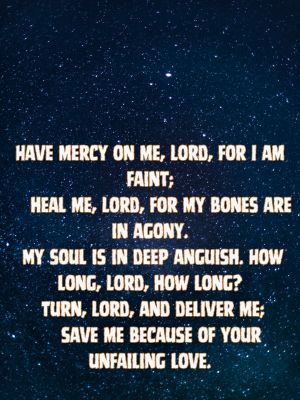







Psalms 6:2-4
For me, this is the most powerful scripture in the Bible for healing.
We’re asking for help, but notice it’s not a passive plea. We’re appealing to a higher power, our values, or a sense of purpose – something that gives us strength. I would argue this “unfailing love” could be our own capacity for resilience, our determination to overcome challenges.
In the quiet moments of prayer, we can enter a space of reflection. Here, our thoughts slow down, and we can begin to identify the things we truly need – perhaps strength to face a challenge, clarity to make a decision, or even just a sense of peace. This self-awareness becomes a foundation for action. Reciting a familiar prayer can lull the mind into a rhythm, creating a space for deeper contemplation of the words’ meaning and the needs they express. It can also trigger a mysterious process of inner healing by aligning all one’s resources and put them to work.
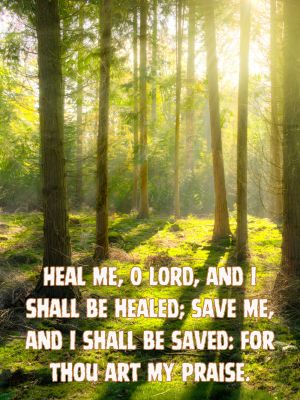
Jeremiah 17:14
It is powerful and heartfelt prayer and it is a plea from the prophet Jeremiah to the Lord, expressing his deep trust in God’s healing and saving power.
While, this might seem like a simple plea for divine intervention, there’s more to it than that. The verse says, “Heal me, O Lord.” It’s not a passive request for some magical fix. You’re acknowledging your own agency in your healing. Perhaps you need to change your habits, take action to address the root of the problem. You’re not a helpless victim. You’re asking for God’s help, but you’re also taking ownership of your own recovery.
Finally, “for thou art my praise.” ties it all together. Maybe facing your problems, taking responsibility, and actively working towards healing brings you closer to something larger than yourself. Maybe it strengthens your character, your resolve. And that, in itself, becomes a form of praise, a way you find meaning in the struggle.
Psalm 91
It is a powerful song of protection and trust in God. It’s about building a foundation – a rock-solid foundation – for your life.
It is a call to action. What are the things you hold dear? What’s your guiding light in this often-dark world? Solidify those beliefs, articulate them clearly, and build your life on that foundation. Because a strong foundation, a strong sense of purpose, that’s the first step towards setting your shoulders back, taking responsibility, and venturing out into the world with confidence.
Thus, The Lord being the refuge and the fortress signifies the importance of having a strong center, a set of values and beliefs that act as your shelter in chaotic times. And the covenant “in him I will trust” it’s about aligning yourself with something bigger than yourself, something that gives your life structure and direction.
Isaiah 41:10
This verse is a message of empowerment. It’s about taking responsibility for your own well-being, facing your fears, and building the strength you need to overcome life’s obstacles. It’s about standing tall on the foundation of your own righteousness, whatever that means to you.
This isn’t some promise that life will be easy. It’s about facing your fears head-on, knowing you’re not alone. Dismay is what happens when you feel overwhelmed by life’s challenges. This verse is a reminder that you have the power to overcome them. It’s about adopting a can-do attitude, a belief in your own capacity to deal with whatever comes your way.
Now, this isn’t about sitting on your laurels waiting for help to magically appear. It means putting in the work, taking the steps necessary to overcome your challenges. When you act with purpose, when your actions align with your values, that’s a source of strength. It gives you something to stand on, a moral compass to guide you through tough times.
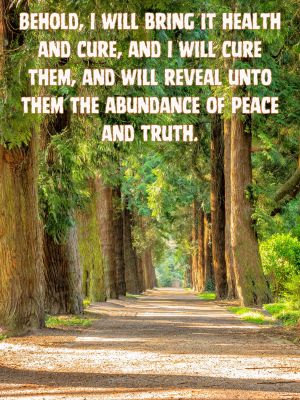
Jeremiah 33:6
We find here a beautiful promise from our Lord. He assures us that He will bring health and cure to our wounded hearts, minds, and souls.
In this context, I would interpret the verse as a call to confront and atone for one’s own transgressions and iniquities. The “wounds” and “bruises” mentioned here may symbolize the pain and struggle one must endure to find true peace and healing. This interpretation aligns with the broader philosophy of “bearing one’s cross” and facing the reality of one’s own shortcomings in order to grow and improve.
There is also here a parallel implied between the suffering of the individual and the collective suffering experienced by humanity throughout history. I would argue that, just as the individual must confront their own darkness to find peace, so too must society face its collective darkness and strive for redemption.
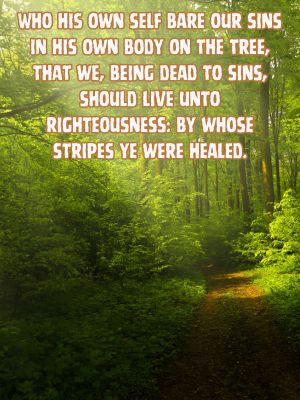
1 Peter 2:24
In 1 Peter 2:24, we find a powerful reminder of the sacrifice that our Lord Jesus Christ made for us.
This passage, then, becomes a call to personal accountability. Are we honest with ourselves about our shortcomings? Are we actively working to become a better person? Because that’s where true healing and righteousness come from – not from some external sacrifice, but from the internal struggle for self-improvement. The willfully taken sacrifice is essential for living a meaningful life. And as Christ bore the stripes of our sins, we are now empowered to try and live a responsible life.
We have then here the recipe: for taking responsibility for the consequences of our actions and stop the negative behaviors that hold us back (being “dead to sins”), we can experience the true healing. It’s the effort, the struggle, the facing of our own darkness that ultimately sets us free.
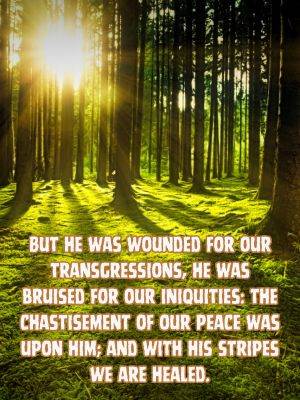
Isaiah 53:5
This passage, however you interpret it literally or metaphorically, can be a call to action. Are we facing the consequences of our choices? Are we taking responsibility for our part in the world’s problems? Because that’s where the healing, the “stripes” come in. It’s a tough lesson, but one worth considering.
We all make mistakes, act out of our deepest flaws. That can cause a lot of chaos, both personally and in the world. This passage suggests that this chaos has a cost. And someone has to step up and shoulder that burden to restore order – the “chastisement of our peace.”
The suffering, the taking on of responsibility, is what allows for healing. It’s not about punishment, but about taking responsibility for the consequences of our actions. The truth conveyed here is that owning our mistakes, taking responsibility for our actions, is what allows us to move forward and grow. It’s the chaos we create by avoiding that responsibility that truly wounds us.
James 5:16
This passage is a call for vulnerability and social connection. Are we honest with ourselves and the people we trust? Are we actively supporting those around us? Because that’s where true healing and a stronger sense of self come from – not from hiding our flaws, but from confronting them in a supportive community. It’s a tough but ultimately rewarding path to take.
The confession is crucial for self-awareness and growth. Bottling up our mistakes and weaknesses keeps us stuck. Owning up to them, especially to someone we trust, forces us to confront them head-on. It can be a humbling experience, but also a liberating one. Moreover, when we pray, we focus our attention and intention to the desired outcome. And that can be health: both physical and spiritual. One implies the other and atoning for our transgressions brings the healing of our entire being.
In plus, we pray for one another, which highlights the power of intercession. When we pray for someone else, we’re not just helping them; we’re also opening ourselves up to healing. It’s a reciprocal process, a recognition of our interconnectedness and shared humanity.
Psalms 147:3
I see the psalms as promises made by God to us, or even more accurate, covenants.
In this context, I would interpret the verse as a call to confront and atone for one’s own transgressions and iniquities. I would suggest that the “broken in heart” and “wounds” mentioned in the verse symbolize the emotional and psychological suffering one must endure to find true healing and growth. This interpretation aligns with the broader philosophy of “bearing one’s cross” and facing the reality of one’s own shortcomings in order to grow and improve.
The concept of healing is central to the Bible, as it imparts the essential principles for leading a healthy and balanced life. By adhering to the divine guidance and principles outlined in the sacred text, individuals can experience healing in various aspects of their lives. The core message conveyed is that by following God’s rule and living in accordance with these divine principles, one can achieve and sustain physical, emotional, and spiritual well-being.
Proverbs 17:22
This proverb, I feel, is so contemporaneous: it’s about taking responsibility for our own mental state.
A positive attitude is a crucial ingredient for mental and physical health. It doesn’t mean ignoring problems, but rather approaching them with a sense of humor, resilience, and optimism. A positive outlook can boost one’s immune system, improve their coping mechanisms, and help them bounce back from setbacks. While the negativity, cynicism, and a sense of hopelessness can impact ultimately the physical health.
Notice it doesn’t say “be happy all the time.” Life is full of challenges and disappointments. The key is to develop a positive outlook that acknowledges the difficulties but focuses on finding meaning and purpose even in the face of hardship.
Psalms 41:3
On the surface, this seems like a promise of divine intervention for the physically ill. But it is also a metaphor for facing challenges and finding strength within oneself.
Life throws curveballs – illness, setbacks, periods of weakness. The “bed of languishing” could represent any situation where we feel depleted, both physically and emotionally. And this is not a punishment, but a test, an opportunity to build resilience.
Notice it doesn’t say “The LORD will remove the bed of languishing.” This is because challenges are inevitable. This doesn’t mean God does everything for us. It means that even in hardship, there are resources available. It’s about how we handle those challenges, how we use them to grow stronger.
Psalms 103:1-5
I would see this as a call to cultivate an attitude of gratitude. Taking time to appreciate the good things in our life, even the small things, can have a profound impact on our well-being. It shifts our focus away from negativity and towards the positive aspects of our existence.
It’s about aligning ourselves with something larger than us, something that gives our life meaning and purpose. This “something” is God, the ultimate patern, the values of principles which make up the framework for life, to make sense of the world and our place in it.
God is here everything, as He Himself says with other occasions: “I am that I am” – God is the ultimate source of healing, forgiveness, and salvation. He has all-encompassing power, His presence offers a sense of completeness and His love is the driving force behind these blessings. Living by God brings all these blessings in our life.
Prayer’s Power
Prayer’s power lies not in magic, but in its ability to focus the mind and spirit. It can be a sanctuary, a space to shed burdens and anxieties. Through focused reflection, prayer can unveil needs we may have overlooked, sparking a sense of purpose and the strength to address them. Repetition of sacred words can lull the mind into a meditative state, fostering a deep sense of peace and inner calm. Ultimately, prayer’s power lies within ourselves, in the way it empowers us to confront challenges, heal wounds, and find the strength to move forward.
King James Bible (KJV)
The King James Version (KJV) of the Bible, completed in 1611, is a landmark translation known for its beautiful and powerful prose. It has had a profound impact on English literature and culture, influencing countless writers and shaping the way we understand the English language itself. While its archaic language can be challenging for modern readers, the KJV remains a cherished text for many Christians due to its faithfulness to the original Hebrew and Greek texts and its enduringly poetic style. However, some scholars criticize the KJV for its interpretations that reflect the social and political views of its time, and newer translations strive for greater accuracy and accessibility.